- The Evolution of Advertising and the Rise of AI Advertising Networks
- Generative AI’s Impact on Advertising Agencies
- AI Revolutionizing Digital Advertising in 2024
- How AI is Shaping Advertising Strategies
- Predictive Analytics and Personalization
- Content Generation and Optimization
- Location-Based Targeting and Beyond
- AI-Powered Advertising Solutions: Examples and Case Studies
- Creative Content Generation with AI
- Brands Embracing AI in Advertising
- AI-Driven Campaign Optimization
- The Future of AI Advertising Networks
- The Importance of Human Creativity
- Navigating Ethical Considerations
- Preparing for Future Innovations
- Conclusion
The advertising landscape is undergoing a seismic shift, largely due to the rise of AI advertising networks. These networks are not just a future concept; they are actively reshaping how brands connect with consumers, optimize campaigns, and drive revenue. This article explores the transformative impact of AI on advertising, examining how it's changing agency models, revolutionizing digital strategies, and creating new opportunities for retailers and brands alike.
The Evolution of Advertising and the Rise of AI Advertising Networks
The advertising industry has a rich history, evolving from simple space brokerage to complex strategic partnerships. In the early days, agencies acted as intermediaries, buying and reselling ad space. However, with the advent of television and the diversification of media channels, agencies expanded their services to include creative development and brand strategy. The digital age brought new domains like SEO and social media marketing, leading to a demand for branded content across platforms. Today, AI advertising networks are poised to disrupt these established models once more.
Generative AI's Impact on Advertising Agencies
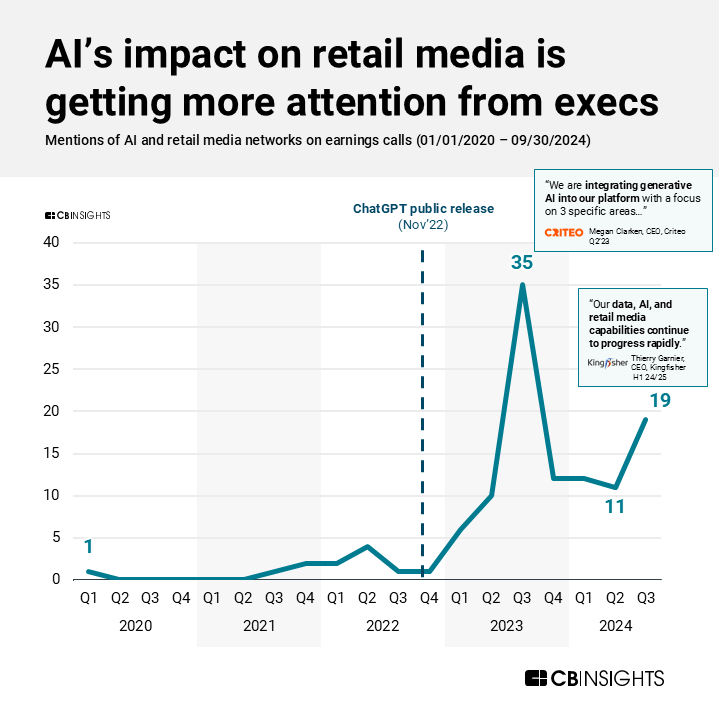
Generative AI's ability to create content, from ad copy to visuals, is fundamentally altering agency operations. Tasks that once took months can now be completed in minutes. This has significant implications for agency revenue models, which historically relied on billable hours for content creation. Agencies are now forced to pivot towards areas where human creativity and strategic insight still hold the edge.
Credit: cbinsights.com
AI Revolutionizing Digital Advertising in 2024
In 2024, AI is the cornerstone of innovation in digital advertising. It powers targeted advertising, dynamic pricing, and content optimization. AI algorithms analyze vast datasets to predict consumer behavior, enabling highly targeted campaigns. This includes personalization at scale, delivering content tailored to individual user preferences. AI is also revolutionizing programmatic advertising, automating ad buying and placement in real-time. Additionally, AI-driven chatbots are enhancing customer experience through personalized recommendations and real-time communication. These advancements show how AI advertising networks are becoming indispensable.
How AI is Shaping Advertising Strategies
AI's influence extends to nearly every facet of advertising strategy. From predictive analytics to content creation, AI is providing new tools and techniques for brands to connect with their target audiences more effectively.
Predictive Analytics and Personalization
AI's power in predictive analytics allows advertisers to accurately forecast trends and preferences. This enables brands to craft highly targeted campaigns that resonate with specific audience interests. AI advertising networks use this data to personalize content, enhancing the user experience and fostering brand loyalty. This means that each user sees an ad that is tailored to their unique tastes and preferences, significantly increasing the likelihood of engagement.
Content Generation and Optimization
Generative AI is transforming content creation. From crafting ad copy to designing logos and producing high-quality images and videos, AI tools can automate many tasks, freeing up human creatives to focus on strategy and ideation. This shift is also creating opportunities for real-time content optimization, ensuring that ads are always relevant and engaging. This is a major component of AI advertising networks.

Credit: ads.google.com
Location-Based Targeting and Beyond
AI is also enhancing location-based targeting, helping advertisers understand customer travel patterns for better mobile ad placement. This level of precision allows for more relevant and timely ad delivery, maximizing the impact of advertising campaigns. Furthermore, AI is revolutionizing search, with platforms utilizing AI to connect with consumers at the point of intent. AI advertising networks are expanding their reach through innovative search platforms, creating new frontiers for reaching consumers.
AI-Powered Advertising Solutions: Examples and Case Studies
Several companies are already leveraging the power of AI to transform their advertising efforts. From generating creative content to optimizing campaigns, these examples show the practical application of AI in the advertising industry.
Creative Content Generation with AI
Companies like Rosebud.ai are using AI to generate ideal model faces for ad campaigns, allowing for targeted advertising based on audience demographics. DataGrid is developing AI for automatic whole-body model generation, producing lifelike images for advertising. NEON is creating 'Artificial Humans' capable of conversing and sympathizing, moving beyond simple marketing models to virtual assistants. Synthesia uses AI to generate localized and personalized videos with translation and personalization features. Zalando is using AI to generate high-resolution images of fashion models wearing custom outfits. These examples demonstrate the power of AI advertising networks to create compelling and customized content.
Brands Embracing AI in Advertising
Brands like Heinz, Coke, and Nike are incorporating AI into their advertising strategies. Heinz’s "AI Ketchup" campaign used Dall-E to generate images of ketchup bottles, capitalizing on the AI hype. Coke’s "Create Real Magic" campaign used an AI tool to allow customers to generate their own Coke visuals. Nike's "Never Done Evolving" campaign used AI to create visuals of simulated tennis matches. These campaigns show how AI can be integrated into creative concepts and production processes. These real-world examples show the power of AI advertising networks in action.

Credit: ads.google.com
AI-Driven Campaign Optimization
Companies are also using AI to optimize ad campaigns. Boomi used AI to generate a variety of visuals for their lead generation campaign, resulting in a 3x increase in creative output. D2L Brightspace used AI to create a consistent visual identity, saving 70% of design time. Unigloves used AI to generate photorealistic images for their ad campaign, reducing design time by 57%. SmartNews used AI to create unique sports visuals, reducing design time by 67.5%. These examples showcase the efficiency and cost-effectiveness of AI advertising networks.
The Future of AI Advertising Networks
The future of advertising is inextricably linked to AI. As technology continues to evolve, AI will play an increasingly critical role in how brands connect with their audiences.
The Importance of Human Creativity
While AI can automate many aspects of advertising, human creativity and strategic thinking remain essential. AI advertising networks are most effective when they complement human ingenuity. Agencies that focus on brand consulting, consumer insights, creative ideation, and data analysis will be best positioned to thrive in this new landscape.
Navigating Ethical Considerations
As AI becomes more prevalent, it's crucial to address ethical concerns and privacy issues. Transparency and data protection are vital for building trust with consumers. Marketers must navigate regulatory frameworks and ensure they comply with data privacy laws. This will be a key factor in the responsible growth of AI advertising networks.
Preparing for Future Innovations
The advertising industry must embrace AI-driven methodologies and continuously adapt to the evolving landscape. Staying informed about emerging technologies and ethical practices will be crucial for success. This includes leveraging AI for more sophisticated advertising strategies, such as natural language processing and sentiment analysis. The future of AI advertising networks promises further innovations that will redefine the standards of advertising.
Conclusion
AI advertising networks are transforming the advertising industry, offering new opportunities for creativity, efficiency, and personalization. While AI is automating many tasks, human creativity and strategic insight remain crucial. By embracing this hybrid model, agencies and brands can leverage AI's potential while maintaining the essence of human-driven creativity. The key to success in this new era is to integrate AI as a complement to human capabilities, thereby ensuring the continued growth and relevance of advertising in a rapidly evolving digital world.